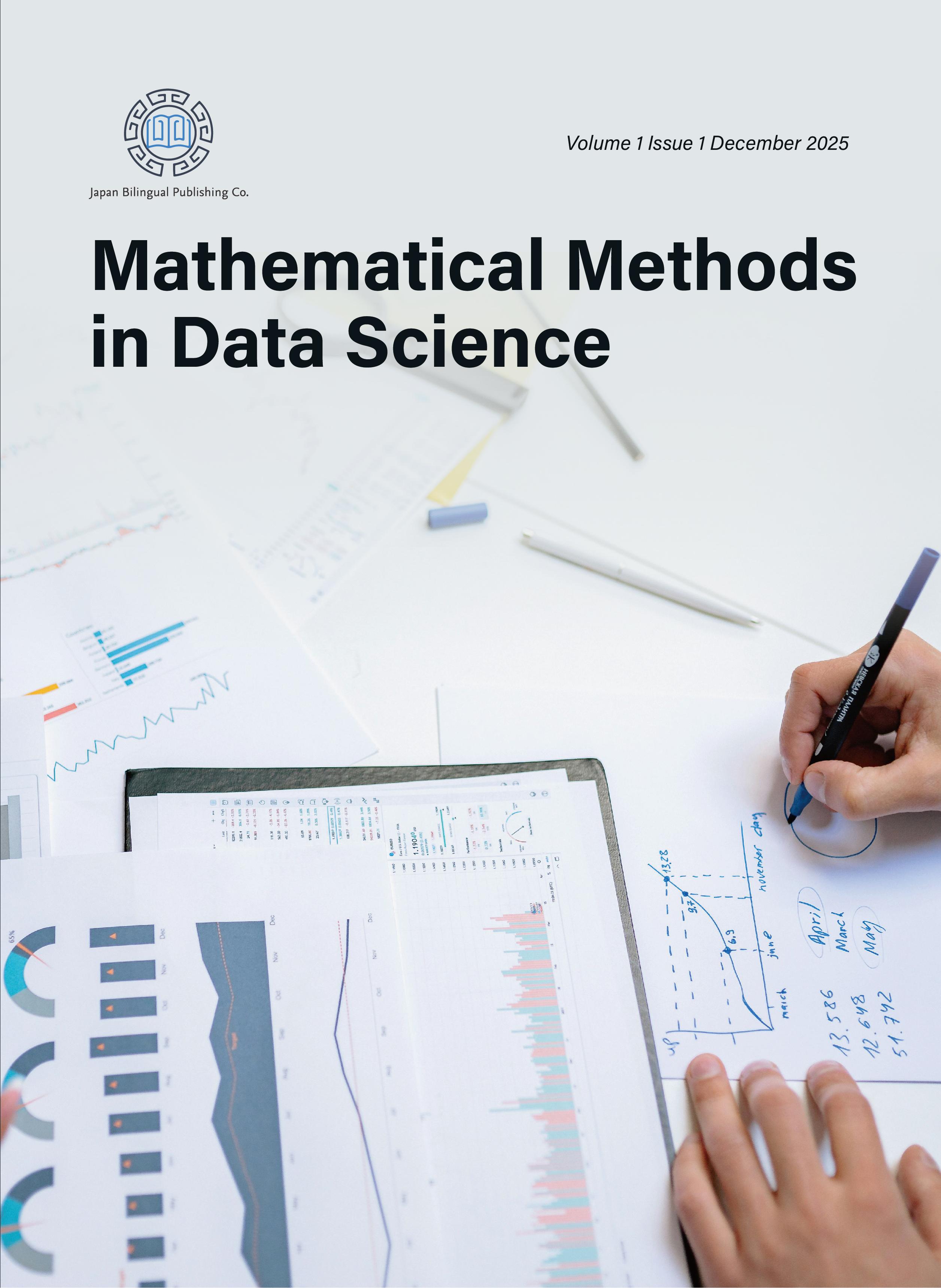


Aim Mathematical Methods in Data Science (MMDS) is an interdisciplinary, peer-reviewed academic journal dedicated to advancing the foundational role of mathematics in driving innovation and rigor in data science. Its core aim is to bridge the gap between mathematical theory and real-world data science applications, publishing high-quality research that develops, refines, or applies mathematical frameworks to address complex data-centric challenges. The journal seeks to foster scholarly dialogue across mathematics, statistics, computer science, and domain-specific fields (e.g., engineering, biology, finance), with the goal of enhancing the theoretical depth, methodological robustness, and practical impact of data science. Additionally, it aims to serve as a resource for researchers, practitioners, and educators—supporting the adoption of rigorous mathematical approaches to solve emerging data problems and shaping the future direction of data science as a discipline.
提交成功
您的期刊投稿申请已提交,我们客服将尽快与您联系
Scope
The journal encompasses a broad range of topics that integrate mathematical methods with data science, including but not limited to:
Foundational mathematical frameworks for data science: Linear and nonlinear algebra, calculus of variations, optimization theory (e.g., convex/non-convex optimization, stochastic optimization), probability theory, and mathematical statistics (e.g., Bayesian inference, hypothesis testing, statistical learning theory) as applied to data analysis.
Machine learning and deep learning: Mathematical foundations of supervised/unsupervised/reinforcement learning; theoretical analysis of neural networks (e.g., convergence, generalization, robustness); mathematical modeling of deep learning architectures (e.g., transformers, graph neural networks).
Data representation and dimensionality reduction: Mathematical methods for feature extraction, manifold learning, sparse representation, and low-rank matrix/tensor decomposition; their application to high-dimensional data (e.g., image, text, sensor data).
Uncertainty quantification and robustness: Mathematical approaches to modeling and mitigating uncertainty in data (e.g., probabilistic programming, fuzzy logic, robust statistics); analysis of data science models under noise, missing data, or adversarial perturbations.
Graph theory and network data science: Mathematical modeling of graph-structured data (e.g., social networks, biological networks); methods for network analysis (e.g., centrality measures, community detection, graph embedding) using combinatorics, algebraic graph theory, or topological data analysis.
Time series and spatio-temporal data: Mathematical methods for time series forecasting (e.g., differential equations, autoregressive models, wavelet analysis); spatio-temporal data modeling (e.g., Gaussian processes, geostatistics) for applications in climate science, epidemiology, or urban analytics.
Domain-specific applications: Mathematical data science methods tailored to fields such as computational biology (e.g., genomic data analysis), finance (e.g., risk modeling, algorithmic trading), engineering (e.g., signal processing, computer vision), and environmental science (e.g., climate data assimilation).
主编
副主编
编委
同行评审是任何学术期刊的主要质量维护措施。在这个过程中,相关领域的专家从各个角度分析学术工作,包括其写作、技术内容的准确性、文献文献以及它对学科的影响和意义。
审稿人在学术出版中起着举足轻重的作用,他们的宝贵意见证明了所考虑文章的质量。同行评审有助于批准研究,建立研究界的评估标准。
首先,在一篇论文提交给期刊后,期刊编辑会筛选稿件,并决定是否将其送交同行评审。只有在通过初步筛选后,稿件才会发送给两名同行评审员。最后,期刊编辑或期刊编委员会考虑同行评审员的报告,并做出接受或拒绝发表手稿的最终决定。通用同行评审流程对此进行了可视化。
1. 国家新闻出版署官网可查真实 CN 刊号,且刊号与期刊名称、主办单位一致; 2.知网 / 万方 / 维普等主流数据库正常收录其过往期刊内容,且更新及时; 3.有官方正规投稿渠道(官网在线投稿系统 / 官方指定邮箱),无私人微信 / QQ 直接收稿的情况。 4.假刊 / 套刊特征:无正规 CN 刊号、数据库不收录、私人渠道收稿、承诺快速发表(1 周内录用)、版面费远低于市场价。
署名要求:必须是实际参与论文研究 / 写作的人员,禁止挂名、冒名,核心刊会核查作者贡献度。 作者数量:普刊一般 1-3 人,核心刊可 3-5 人,过多作者会被期刊社质疑贡献度。
无全国统一格式,但同期刊有严格的固定格式,核心要求包含:标题(一般 20 字内)、作者信息(姓名 / 单位 / 邮编 / 学历 / 职称)、摘要(中文 200-300 字,核心刊需英文摘要)、关键词(3-8 个)。投稿前必须下载目标期刊的《征稿简则》/《投稿须知》,严格按要求排版,格式错误会直接初审拒稿。

本站仅提供正规合法期刊咨询服务,非期刊官网,不涉及出版事务,无投稿绿色通道,录用结果以出版商通知为准,第三方商标归原权利人所有。